The Effectiveness of Galvanized Concertina Wire
Release time:2026-02-28 Click:9
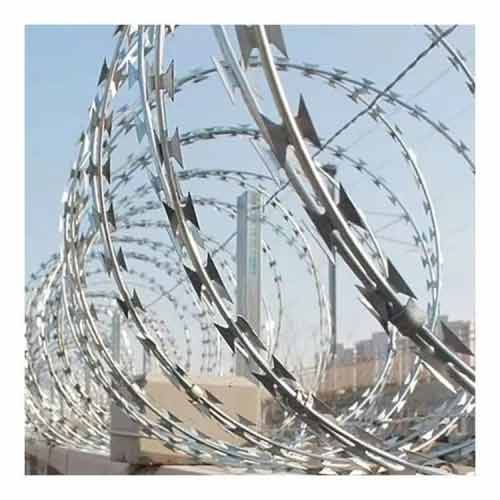
Galvanized concertina wire, a formidable barrier in high-security fencing, combines sharp, blade-like edges with a corrosion-resistant coating to deter intrusions. Its name derives from its concertina-like coiled structure, which unfurls into a dense, impassable barrier when deployed. Used in prisons, military bases, and border zones, this wire is engineered to resist cutting, climbing, and weathering, making it a critical component of perimeter security systems. Understanding its design, applications, and advantages reveals why it remains a trusted choice for protecting sensitive areas.
The construction of galvanized concertina wire is a study in defensive engineering. It consists of a central core of high-tensile steel wire, around which sharp, reciprocating blades (triangular or trapezoidal) are helically wound. The galvanization process—submerging the wire in molten zinc—creates a 50–100 micron thick coating, protecting it from rust in coastal, industrial, or tropical environments. Two main types exist: single-coil (used for standalone barriers) and double-coil (with opposing spirals for added complexity). Blade lengths range from 22–47 mm, with closer spacing (25–50 mm) increasing difficulty of traversal.
Applications of galvanized concertina wire are concentrated in high-risk security scenarios. Prisons and detention centers top its use, lining perimeter fences to prevent escapes. Military installations deploy it to secure borders, depots, and forward operating bases, often combined with electric fences. Critical infrastructure like power plants and data centers use it to deter sabotage, while private estates with high-value assets (e.g., jewelry stores) employ it as a last-line defense. In conflict zones, it serves as a temporary barrier to channel enemy movements or protect refugee camps.
Advantages of galvanized concertina wire over other security measures are stark. Its sharp blades inflict painful cuts, psychologically deterring climbers more effectively than smooth wire. The galvanized coating ensures a 20–30 year lifespan, even in harsh conditions, outperforming non-galvanized alternatives. Unlike solid walls, it is transparent, allowing guards to monitor activity behind the barrier. It is also cost-effective: installation requires minimal labor, and repairs involve replacing individual coils rather than entire fences. For temporary needs (e.g., event security), it can be quickly deployed and removed.
Installation of galvanized concertina wire demands precision to maximize effectiveness. First, a support structure (chain link fence, concrete wall, or steel posts) is erected, with brackets spaced 1–1.5 meters apart. The wire is unrolled and stretched taut, with coils overlapped by 10–15 cm to eliminate gaps. Ends are capped with barbed tips to prevent unraveling, and tensioners are used to maintain tightness. On slopes, the wire is cut to follow the gradient, ensuring uniform height. Safety precautions are critical: installers wear thick gloves and goggles to avoid blade injuries, and warning signs are posted to alert passersby.
Maintenance of galvanized concertina wire ensures sustained security. Biannual inspections check for rust spots (touch up with zinc paint), bent blades, or loose attachments. Vegetation growing near the wire is trimmed to prevent corrosion from sap. In snowy regions, coils are cleared to avoid sagging under weight. For damaged sections, individual coils are replaced, with damaged blades straightened or removed. As security threats evolve, galvanized concertina wire adapts—some variants now integrate sensors to detect tampering. This timeless barrier, thus, remains a cornerstone of defense, balancing lethality with durability.
Previous article:High Security Railway Line Concertina Wire for Intrusion Prevention
Next article:Anti-Climb Port Security Concertina Wire for Dock & Warehouse Perimeter Defense
Hot products
Mobile: +86 15369215227
Email:metalproducts2022@163.com
Email:1626757181@qq.com