Choosing Between Threat Levels: Barbed Wire vs Concertina Wire
Release time:2026-03-05 Click:6
When designing perimeter security for prisons, military installations, or critical infrastructure, the choice between barbed wire vs concertina wire hinges on threat assessment, legal constraints, and desired deterrence psychology—each offering distinct mechanical and perceptual advantages in layered defense strategies.
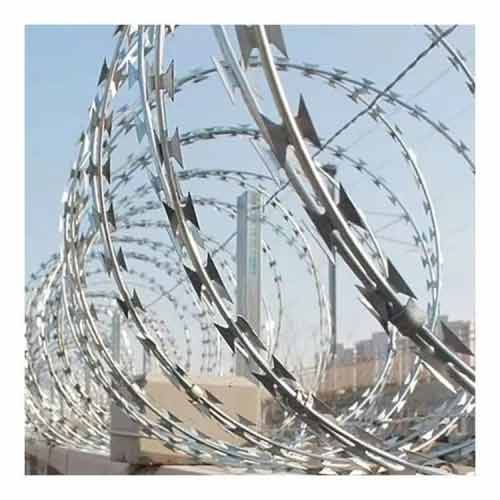
Barbed wire consists of two high-tensile steel strands twisted together with sharp barbs spaced every 4–6 inches. It is typically stretched taut along fence tops in straight lines or angled arms. While effective against casual trespassers, it can be breached with gloves or blankets. Concertina wire, by contrast, is a helical coil of razor-sharp tape (often called “razor wire”) that entangles limbs and clothing, causing deep lacerations with minimal contact—making it far more formidable.
From an installation standpoint, barbed wire vs concertina wire differs significantly. Barbed wire requires tensioning between posts and is relatively lightweight. Concertina coils are pre-formed and simply laid atop existing barriers, but their weight (up to 10 kg per linear meter) demands robust support structures. Maintenance of concertina is higher due to sagging and debris accumulation, whereas barbed wire is easier to inspect and replace.
Legally, many countries restrict concertina wire in civilian zones due to its lethality, permitting only barbed variants with blunt tips or minimum mounting heights. Human rights organizations often oppose concertina use near refugee camps or borders, citing excessive force. Thus, the barbed wire vs concertina wire debate extends beyond engineering into ethics and policy.
In conclusion, while both serve as physical and psychological barriers, concertina wire is a high-intensity solution for maximum-security scenarios, whereas barbed wire offers proportional deterrence for agricultural or low-risk commercial perimeters. The right choice aligns threat reality with societal values.
Previous article:Hot-Dip Galvanized Concertina Wire
Next article:Designing Effective Security Fence Solutions
Hot products
Mobile: +86 15369215227
Email:metalproducts2022@163.com
Email:1626757181@qq.com