Analyzing Perimeter Security: Barbed Wire vs Concertina Wire
Release time:2026-02-10 Click:12
When enhancing a security perimeter, the choice of topping or barrier type is critical. Two prevalent options are traditional barbed wire and its more formidable cousin, concertina wire. While both serve as physical and psychological deterrents, understanding the key differences in their design, deployment, and effectiveness—barbed wire vs concertina wire—is essential for selecting the right solution for a given threat level and application.
Traditional barbed wire consists of two twisted strands of steel wire with sharp barbs spaced at regular intervals. It is typically installed in taut, parallel strands along fence tops or on outrigger arms. Its primary function is to deter climbing by making it painful and difficult to grip. It is cost-effective, widely available, and suitable for agricultural boundaries, lower-security industrial sites, and as a general deterrent where a significant physical barrier already exists.
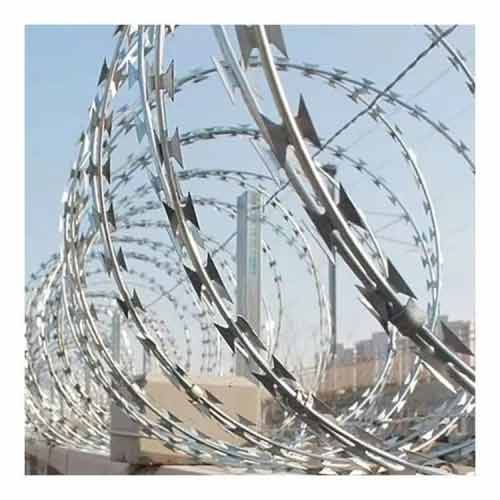
Concertina wire, also known as coiled barbed tape or razor wire, represents a significant escalation in security. It is manufactured from a high-tensile steel strip punched into sharp, blade-like barbs, then coiled into a large, spring-like cylinder. When deployed, it expands into a dense, tangled mass that is extremely difficult to penetrate or climb over. The blades are designed to inflict severe lacerations, making it a far more aggressive barrier. It is often installed in multiple stacked coils or as a massive, freestanding obstacle.
The deployment methods highlight their different roles. Barbed wire is a linear barrier, often used to augment an existing fence line. Concertina wire can be used as a topping but is also effective as a standalone, portable barrier that can be quickly uncoiled to block breaches, secure perimeters temporarily, or create impassable zones. Its intimidating presence and formidable physical structure make it the standard for high-security facilities like prisons, military bases, and border controls.
From a maintenance and safety perspective, concertina wire requires more careful handling during installation due to its extreme sharpness, mandating full protective gear. Both types need regular inspection for damage or rust, but concertina wire's complex coils can be harder to inspect thoroughly. The psychological impact also differs; barbed wire signals a restricted area, while concertina wire communicates a severe, high-risk boundary where trespassing will result in serious injury.
The decision between barbed wire vs concertina wire hinges on the required level of deterrence and delay. For deterring casual intruders or containing livestock, barbed wire is often sufficient. For protecting high-value assets, critical infrastructure, or in areas with a high risk of determined intrusion, concertina wire provides a superior, multi-dimensional obstacle designed to stop, entangle, and delay adversaries long enough for a security response to intervene. It is the clear choice where security cannot be compromised.
Previous article:Enhancing Security with Razor Concertina Wire
Next article:Where Flexibility Meets Formidable Defense: Stainless Steel Concertina Barrier
Hot products
Mobile: +86 15369215227
Email:metalproducts2022@163.com
Email:1626757181@qq.com