Product details description
Concertina wire, a type of razor wire formed into large coils for rapid
deployment, is a premier perimeter security solution, but its effectiveness is
nullified if corrosion compromises the sharp edges or structural integrity. In
harsh environments—such as coastal regions with salt spray, chemical plants with
acidic fumes, or arctic zones with freeze-thaw cycles—standard carbon steel wire
will rust rapidly, becoming brittle and ineffective. Therefore, selecting the
right corrosion-resistant material, specifically high-quality galvanized steel
or stainless steel, is critical for ensuring the longevity and lethality of the
barrier.
Hot-dip galvanized concertina wire is the most common and cost-effective
option for general outdoor security. The process involves dipping the steel wire
into a bath of molten zinc, creating a metallurgical bond that acts as a
sacrificial anode. Even if the surface is scratched during installation, the
zinc corrodes preferentially to the underlying steel, protecting the core. For
concertina wire, the coating thickness is crucial; a standard Class A coating
(0.30 oz/ft2) may suffice for mild climates, but in severe environments, a Class
C or heavy-duty coating (1.00 oz/ft2 or more) is required. This thick layer
ensures that the wire can withstand decades of exposure without the rust
"bleeding" onto the surface and dulling the blades.
Stainless steel concertina wire represents the premium tier of corrosion
resistance, particularly for high-value assets like power plants, prisons, and
offshore oil rigs. The most common grade used is AISI 304, which contains 18%
chromium and 8% nickel, providing excellent resistance to oxidation. However, in
chloride-rich environments (like seawater), Grade 316 (marine grade) is
mandatory because it contains 2-3% molybdenum, which significantly enhances
resistance to pitting and crevice corrosion. Unlike galvanized wire, stainless
steel does not rely on a coating; the corrosion resistance is inherent to the
alloy, meaning that even if the wire is cut or deeply scratched, it will not
rust structurally.
The manufacturing process for these wires differs slightly to accommodate
the materials. Stainless steel is harder and less ductile than carbon steel,
requiring higher tension forces during the stamping and coiling process. This
means that the clips and ties used to hold the coils together must also be made
of stainless steel to prevent galvanic corrosion. If a standard carbon steel
clip is used on a stainless steel coil, the clip will rust away rapidly due to
the electrochemical reaction between the two dissimilar metals. Therefore,
"all-stainless" construction is the industry standard for these high-end coils
to ensure uniform durability.
Aesthetic and maintenance considerations also play a role in material
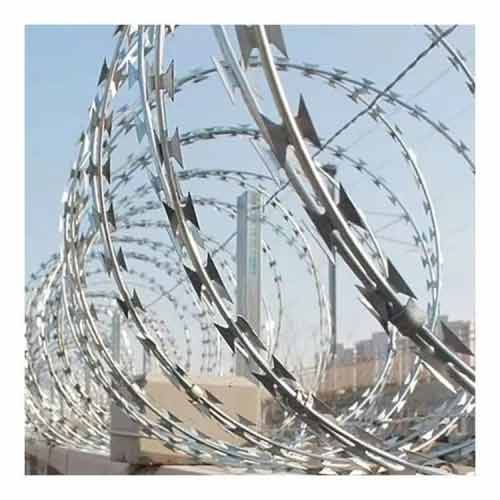
selection. Galvanized wire has a bright, spangled finish that is highly visible,
serving as a psychological deterrent. However, over time, it weathers to a dull
gray. Stainless steel maintains a bright, silvery luster indefinitely, which is
desirable for high-profile installations where appearance matters. Maintenance
for galvanized wire involves periodic inspection for "white rust" (zinc
corrosion products) in humid, stagnant air, which can be treated with a
zinc-rich paint. Stainless steel requires almost no maintenance, aside from
washing to remove surface contaminants like iron particles from nearby
construction or salt deposits, which can cause surface staining (tea staining)
if left uncleaned.
Ultimately, the choice between galvanized and stainless steel concertina
wire is a lifecycle cost analysis. While stainless steel is 3 to 4 times more
expensive upfront, its lifespan in aggressive environments can exceed 30 years,
compared to 10-15 years for heavy-duty galvanized wire. For temporary perimeters
or budget-constrained projects, galvanized wire offers the best balance of cost
and performance. For permanent, critical infrastructure where replacement is
difficult or dangerous, the investment in stainless steel is justified by its
reliability and zero-maintenance profile.
Previous article:
Anti-Climb Concertina Wire - Effective Perimeter Intrusion Prevention
Next article:
Quick-Deploy Concertina Wire - Security Barrier